martes, 14 de junio de 2016

lunes, 23 de marzo de 2015
GUIA DE INGLES A1.
GUIA DE INGLES A1.
Observe que en el modo afirmativo, en la 3º persona del singular, se le añade una “S” al verbo.
Negative form
The structure of the negative structure is formed by adding the auxiliaries do or does plus the negation not
Do + not —> don’t
Does + not —> doesn’t
These auxiliaries are used TO HELP you. When you use the auxiliary the verb is always in its simple.
Remember:
In positive we had 2 conjugations for every verb (not to be)
- play/plays , work/works, study/studies, watch/watches, etc…
The conjugation is simple: HE / SHE / IT —- with the “s” form and I / WE / YOU / THEY —- simple form
Examples:
My brother works for IBM.
My parents live in Paris.
IN THE NEGATIVE FORM THE AUXILIARY CHANGES FORM AND NOT THE VERB.
He / she / it + doesn’t + verb (simple form)
I / We / You / They + don’t + verb (simple form)
Nota del profesor:Como vemos, lo que se conjuga en la forma negativa es el auxiliar y no el verbo. Es decir, uno va elegir entre don’t y el doesn’t pero el verbo SIEMPRE estará en su forma simple (sin la terminación “s”)
Question form
The question structure is formed by following the following structure
Question word + [do / does + SUBJECT + Verb (simple form)] + Complement
We use the auxiliaries do and does in the question form and they have to agree with the subject
The conjugation is the following:
Does —–> he/she/it
Do ———-> I/we/you/they
The verb ALWAYS stays in the simple form (not with the “s” form)
Short Answers
Las respuestas cortas son con los auxiliares do y does con la forma positiva y don´t y doesn’t con la forma negativa. La respuesta corta se refiere a cuando responde solo si o no.
Do you study English for free in InglesTotal? ———-> Yes, I do
The auxiliaries appear in the negative and question form with the verbs that are not to be.
Example:
(+) Juan plays soccer.
(-) He doesn’t play soccer.
(?) Does he play soccer?
*VERB TO BE (NO AUXILIARIES!!!)
(+) She is a teacher
(-) She isn’t a teacher.
(?) Is she a teacher?
Nota: Recuerden que cuando usen el verbo to be (es decir cualquier conjugacion de ser o estar en el presente) no se usan los auxiliares puesto que estos se usan solo con los demas verbos y en negativo y en pregunta)
Ejercicios: Presente Simple (Simple Present Tense)
Con verbos en Presente Simple
En este caso, dependerá del tipo de oración. Sí, ya sé que es un lío, pero si te re-lees esta entrada un par de veces seguro que te queda más claro ;-).
Preguntar por la
frecuencia
Afirmativa
0 % ------------------------------------------------------ 100 %
never
sometimes
often
usually
always
En la forma afirmativa, el adverbio de frecuencia se coloca
delante del verbo.
Ej: I usually play football at the weekend.
Recuerda
Si el verbo principal de la frase es el verbo be, el adverbio de frecuencia se coloca detrás del verbo.
He´s always late.
Interrogativa
En la forma interrogativa, el adverbio de frecuencia se coloca entre el sujeto y el verbo principal.
I love playing sport.
I don´t like watching TV.
Do you often have breakfast in bed?
Usos
Este tipo de adverbios se utiliza para hablar de la frecuencia con la que hacemos las cosas.
Ejercicios
Colocar el adverbio de frecuencia
1. He listens to the radio. (often)
_____________________________
2. They read a book. (sometimes)
_____________________________
3. Pete gets angry. (never)
_____________________________
4. Tom is very friendly. (usually)
_____________________________
5. I take sugar in my coffee. (sometimes)
_____________________________
6. Ramon is hungry. (often)
_____________________________
7. My grandmother goes for a walk in the evening. (always)
_____________________________
8. Walter helps his father in the kitchen. (usually)
_____________________________
9. They watch TV in the afternoon. (never)
_____________________________
10. Christine smokes after dinner. (seldom)
_____________________________
Colocar el adverbio de frecuencia
1. He plays golf on Sundays. (sometimes)
_____________________________
2. The weather is bad in November. (always)
_____________________________
3. It rains in California. (never)
_____________________________
4. We have fish for dinner. (seldom)
_____________________________
5. She will see him. (rarely)
_____________________________
6. Peter doesn´t get up before seven. (usually)
_____________________________
7. They do not play tennis on Sundays. (always)
_____________________________
8. Mary watches TV. (hardly / ever)
_____________________________
9. I go to school by bus. (always)
_____________________________
10. I get up at seven. (usually)
_____________________________
11. I watch TV in the evening. (often / frequently)
_____________________________
12. I have lunch in a restaurant. (sometimes)
_____________________________
13. I have breakfast. (seldom)
_____________________________
14. I arrive late. (never)
_____________________________
15. I have homework. (every day)
_____________________________
Comidas
Vocabulary At the restaurant
2) The guest
Countable/Uncountable Nouns (Los
nombres contables/incontables)
Countable Nouns (Los nombres
contables)
Los nombres o sustantivos contables son aquellos que se pueden contar.
Uncountable Nouns (Los nombres
incontables)
Los nombres o sustantivos incontables son aquellos que no podemos contar porque no los podemos delimitar individualmente sino que forman parte de un todo. Son tratados como singulares (no se pueden hacer plurales añadiendo '-s').
Sin embargo, en el momento que los delimitamos, estos mismos nombres o sustantivos pasan a ser contables. Deberán ir precedidos, si quieren individualizarse, de alguna palabra con valor partitivo.
Grammatical Rules (Reglas
gramaticales)
Some /
Any / Much / Many
Some A little, a few or small number or amount.
We usually use some in positive sentences for countable and uncountable nouns.
I have some friends in London.
I usually drink some wine with my meal.
Sometimes we use some in a question, when we expect a positive YES answer.
Would you like some more tea?
Could I have some more sugar please?
Any One, small or all. It is used with negative sentences.
When asking questions and when a sentence is grammatically positive, but the meaning of the sentence
is negative.
Do you have any ice cream left for me?
My brother never does any chores.
We use any for both countable and uncountable nouns.
Do you have any cheese?
He doesn't have any friends in Paris.
Much It is used with uncountable nouns.
They don't have much money to buy a present.
Many It is used with countable nouns.
I don't have many English stamps in my collection.
Much and Many are used to express that there is a large quantity of something.
2. ¿CUÁNDO USAR LAS
PREPOSICIONES DE LUGAR: “IN”, “ON” Y “AT” EN INGLÉS?
Las preposiciones de lugar en inglés: IN, ON y AT traen más de un quebradero de cabeza a los estudiantes de nivel intermedio, especialmente en el inglés escrito y hablado. Hoy vamos a acabar con esta problemática memorizando unas reglas sencillas para aprender a diferenciar cuándo usar uno u otro. Son pocas y sencillas. Merece la pena dominarlas para darle un empujón a la gramática y mejorar nuestro inglés. Espero que os resulte útil.
2.1. Cuándo utilizar la preposición “IN”: “Dentro de”, “en (interior)”
2.2. Cuándo utilizar la preposición “ON”: “Sobre”, “encima de”
2.3. Cuándo utilizar la preposición “AT”: “En”, “junto a”, “al lado de”
Presente Simple – (Simple Present Tense)
El Presente Simple es un tiempo verbal
que se utiliza para describir acciones habituales que suceden con cierta
frecuencia y no hace referencia a si está ocurriendo en el momento actual.
I play tennis. Yo juego al tenis.
(Hace mención de un deporte que realizo cotidianamente y que no necesariamente lo estoy jugando en este momento).He works in an office. Él trabaja en una oficina.
(Se refiere al trabajo que desarrolla una persona frecuentemente). They travel to Madrid. Ellos viajan a Madrid.
(Habla de un viaje que se repite a diario, aunque el sujeto no lo esté realizando ahora).
(Hace mención de un deporte que realizo cotidianamente y que no necesariamente lo estoy jugando en este momento).He works in an office. Él trabaja en una oficina.
(Se refiere al trabajo que desarrolla una persona frecuentemente). They travel to Madrid. Ellos viajan a Madrid.
(Habla de un viaje que se repite a diario, aunque el sujeto no lo esté realizando ahora).
Observe que en el modo afirmativo, en la 3º persona del singular, se le añade una “S” al verbo.
He eats vegetables. Él come vegetales.
Alice dances at the theatre. Alice baila en el teatro.
The dog breaks the fence. El perro rompe la cerca.
Alice dances at the theatre. Alice baila en el teatro.
The dog breaks the fence. El perro rompe la cerca.
En el modo interrogativo y negativo se utiliza
el auxiliar DO, aunque en la 3º persona del singular se coloca
como auxiliar DOES y se le quita la “S” al verbo.
Existen algunos casos particulares como
por ejemplo, si el verbo empleado termina en “SS”, “SH”, “CH”, “O” y “X” al
formar la 3º persona del singular en la forma afirmativa se le agrega “ES”.
Aquí vemos algunos ejemplos:
Si el verbo es FISH (pescar), se
conjugará: He fishes at the sea. Él pesca en el mar.
Si el verbo es KISS (besar), se conjugará: She kisses to her boyfriend. Ella besa a su novio.
Si el verbo es WATCH (observar), se conjugará: He watches the mountain. Él observa la montaña.
Si el verbo es FIX (arreglar), se conjugará: He fixes his car. Él arregla su coche.
Si el verbo es GO (ir), se conjugará: She goes to the office. Ella va a la oficina.
Si el verbo es KISS (besar), se conjugará: She kisses to her boyfriend. Ella besa a su novio.
Si el verbo es WATCH (observar), se conjugará: He watches the mountain. Él observa la montaña.
Si el verbo es FIX (arreglar), se conjugará: He fixes his car. Él arregla su coche.
Si el verbo es GO (ir), se conjugará: She goes to the office. Ella va a la oficina.
Otra excepción se presenta si el verbo termina en
“Y” tras consonante. Para formar la 3º persona del singular se sustituye esta
“Y” por una “i” acompañada de la terminación “ES”. Por ejemplo:
Si el verbo es STUDY (estudiar) se
conjugará: She studies the lesson. Ella estudia la lección.
Para la forma negativa se puede emplear la forma
contraída de DON’T en lugar de DO
NOT o DOESN’T en vez de DOES NOT.
I don’t play tennis. Yo no juego al
tenis.
He doesn’t work in an office. Él no trabaja en una oficina.
They don’t travel to Madrid. Ellos no viajan a Madrid.
He doesn’t work in an office. Él no trabaja en una oficina.
They don’t travel to Madrid. Ellos no viajan a Madrid.
Negative form
The structure of the negative structure is formed by adding the auxiliaries do or does plus the negation not
Do + not —> don’t
Does + not —> doesn’t
These auxiliaries are used TO HELP you. When you use the auxiliary the verb is always in its simple.
Remember:
In positive we had 2 conjugations for every verb (not to be)
- play/plays , work/works, study/studies, watch/watches, etc…
The conjugation is simple: HE / SHE / IT —- with the “s” form and I / WE / YOU / THEY —- simple form
Examples:
My brother works for IBM.
My parents live in Paris.
IN THE NEGATIVE FORM THE AUXILIARY CHANGES FORM AND NOT THE VERB.
He / she / it + doesn’t + verb (simple form)
I / We / You / They + don’t + verb (simple form)
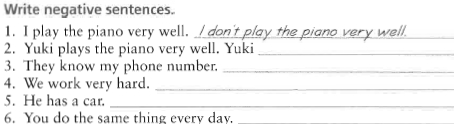
Nota del profesor:Como vemos, lo que se conjuga en la forma negativa es el auxiliar y no el verbo. Es decir, uno va elegir entre don’t y el doesn’t pero el verbo SIEMPRE estará en su forma simple (sin la terminación “s”)
Question form
The question structure is formed by following the following structure
Question word + [do / does + SUBJECT + Verb (simple form)] + Complement
We use the auxiliaries do and does in the question form and they have to agree with the subject
The conjugation is the following:
Does —–> he/she/it
Do ———-> I/we/you/they
The verb ALWAYS stays in the simple form (not with the “s” form)
Short Answers
Las respuestas cortas son con los auxiliares do y does con la forma positiva y don´t y doesn’t con la forma negativa. La respuesta corta se refiere a cuando responde solo si o no.
Do you study English for free in InglesTotal? ———-> Yes, I do
Yes, (I, you, we, you, they) do. ————
No, ( (I, you, we, you, they) don’t.
Yes, (he,she,it does)————————- No,
(he,she,it )doesn’t
The auxiliaries appear in the negative and question form with the verbs that are not to be.
Example:
(+) Juan plays soccer.
(-) He doesn’t play soccer.
(?) Does he play soccer?
*VERB TO BE (NO AUXILIARIES!!!)
(+) She is a teacher
(-) She isn’t a teacher.
(?) Is she a teacher?
Nota: Recuerden que cuando usen el verbo to be (es decir cualquier conjugacion de ser o estar en el presente) no se usan los auxiliares puesto que estos se usan solo con los demas verbos y en negativo y en pregunta)
Ejercicios: Presente Simple (Simple Present Tense)
1.
I
(travel) ………. to London every week.
1. They (run) ………. in the park every
Saturdays.
1. My mother (clean) ………. the house.
2.
You
(be) ………. a good student..
1. Mary (work) ………. in a bank.
2.
John
(walk)………. to his office..
1. You (study) ………. English at school.
1. The dog (break) ………. the fence
1.
The
car (be) ………. in the garage
2.
My
father (have) ………. a nice coat..
1.
We (live) ………. in Paris.
1. George (sell) ………. peaches and apples.
1. I always (visit) ………. my grandmother.
2. Alice (go) ………. to the church. Alicia va a
la iglesia.
1. They (be) ………. my best friends.
2.
You
always (pay) ………. the tickets.
1.
London
(be) ………. a big and nice city.
1. My cousin (paint) ………. the house.
2. I (study) ………. and (work) ………. in
Madrid.
3.
Mike
never (do) ………. the homework.
|
Los adverbios de frecuencia se utilizan para definir la periodicidad con que se realiza una actividad
determinada. Se usan habitualmente con el presente simple.
Como
ya sabemos, el presente simple se utiliza para hábitos y costumbres, por
tanto, los adverbios de frecuencia nos indicarán cuan a menudo realizamos
estas acciones. Vamos a ver algunos ejemplos.
- I always go to
sleep early– Siempre voy a dormir temprano.
·
You never listen to her– Nunca la
escuchas.
En principio
parece bastante simple, es aprenderse los adverbios de frecuencia
y colocarlos en la frase, pero….los hispano-hablantes tenemos un pequeño
problema con eso: la posición de los adverbios dentro de la frase.
Vamos a
verlo en la frase Victor is often late
En español
podemos decir:
- A menudo Víctor llega tarde
- Víctor llega tarde a menudo
- Víctor a menudo llega tarde.
Es decir, en
español podemos organizar la estructura sintáctica de la frase (el orden de las palabras)
de una manera más flexible que en inglés.
En el caso
de los adverbios, su posición dependerá del verbo al que acompañe.
1) El
adverbio va siempre detrás del verbo si la frase es afirmativa o negativa
- I am always happy – Siempre estoy feliz.
- He isn’t usually bored – Normalmente no está aburrido / No suele estar
aburrido.

2) Si
es una pregunta, el adverbio ira detrás del
sujeto
- Are you
sometimes sad? – ¿A veces estás triste?
Con verbos en Presente Simple
En este caso, dependerá del tipo de oración. Sí, ya sé que es un lío, pero si te re-lees esta entrada un par de veces seguro que te queda más claro ;-).
Veamos:
1) Si
la oración es afirmativa o interrogativa, el adverbio irá entre
el sujeto y el verbo principal:
- I hardly
ever drink beer – Casi nunca bebo cerveza
- Does she
often snore at night? – ¿Ronca (ella) a menudo de noche?
2) Ten en
cuenta que en las negaciones, el adverbio
va entre el verbo auxiliar y el verbo principal:
- I don’t
often go to visit my grandmother –No voy a visitar a mi abuela a menudo
Preguntar por la
frecuencia
Si
quieres preguntarle a alguien con qué frecuencia hace una cosa o
la otra, utilizas el pronombre interrogativo ‘how’ seguido del
adverbio ‘often’:
- How often do
you go to Menorca? – ¿Con qué frecuencia vas a Menorca?
- I go to
Menorca twice a month. – Voy a Menorca dos veces al mes.
Afirmativa
0 % ------------------------------------------------------ 100 %
never
sometimes
often
usually
always
En la forma afirmativa, el adverbio de frecuencia se coloca
delante del verbo.
Ej: I usually play football at the weekend.
Recuerda
Si el verbo principal de la frase es el verbo be, el adverbio de frecuencia se coloca detrás del verbo.
He´s always late.
Interrogativa
En la forma interrogativa, el adverbio de frecuencia se coloca entre el sujeto y el verbo principal.
I love playing sport.
I don´t like watching TV.
Do you often have breakfast in bed?
Usos
Este tipo de adverbios se utiliza para hablar de la frecuencia con la que hacemos las cosas.
Ejercicios
Colocar el adverbio de frecuencia
1. He listens to the radio. (often)
_____________________________
2. They read a book. (sometimes)
_____________________________
3. Pete gets angry. (never)
_____________________________
4. Tom is very friendly. (usually)
_____________________________
5. I take sugar in my coffee. (sometimes)
_____________________________
6. Ramon is hungry. (often)
_____________________________
7. My grandmother goes for a walk in the evening. (always)
_____________________________
8. Walter helps his father in the kitchen. (usually)
_____________________________
9. They watch TV in the afternoon. (never)
_____________________________
10. Christine smokes after dinner. (seldom)
_____________________________
Colocar el adverbio de frecuencia
1. He plays golf on Sundays. (sometimes)
_____________________________
2. The weather is bad in November. (always)
_____________________________
3. It rains in California. (never)
_____________________________
4. We have fish for dinner. (seldom)
_____________________________
5. She will see him. (rarely)
_____________________________
6. Peter doesn´t get up before seven. (usually)
_____________________________
7. They do not play tennis on Sundays. (always)
_____________________________
8. Mary watches TV. (hardly / ever)
_____________________________
9. I go to school by bus. (always)
_____________________________
10. I get up at seven. (usually)
_____________________________
11. I watch TV in the evening. (often / frequently)
_____________________________
12. I have lunch in a restaurant. (sometimes)
_____________________________
13. I have breakfast. (seldom)
_____________________________
14. I arrive late. (never)
_____________________________
15. I have homework. (every day)
_____________________________
Find (see) the pharmacy in front of you
(on your right / on your left, ...): Encuentra (ve) la farmacia delante suya (a
su derecha, a su izquierda, ...)
Go along (the street, the avenue, ...): Continúa a lo largo
(de la calle, avenida, ...)
Go back (till the hotel, …): Vuelve hacia atrás (hasta el
hotel, …)
Go down: Sigue cuesta abajo
Go on: Continúa
Go past (the Post Office, ...): Sigue hasta pasar Correo
Go straight on: Continúa recto
Go to the end (of the street, of the road, …): Continúa hasta el
final (de la calle, de la carretera, ...)
Go up: Sigue cuesta arriba
Halfway down the street (up the street): A mitad de camino calle abajo
(calle arriba, ...)
Take the first (the second, ...) turning on your left (on
your right, ...): Coge la primera calle a mano izquierda
That place is round the corner: Ese lugar está cerca de la esquina
(a la vuelta de las esquina)
That place is at the corner: Ese lugar está en la esquina
Till the corner (the turning, ...): Hasta la esquina (la
bocacalle, …)
Till you see the restaurant
on your right (on your
left, in front of you, opposite you, ...): Hasta que veas el restaurante a tu
derecha
Till you come to the
restaurant: Hasta que
llegues al restaurante
Turn left (right) into the street (the avenue, ...):
Gira a la izquierda y entra en la calle
Comidas
Meat
- Carne
beef
|
carne de vaca
|
pork
|
cerdo
|
chicken
|
pollo
|
bacon
|
bacón
|
ham
|
jamón
|
lamb
|
cordero
|
liver
|
hígado
|
kidneys
|
riñones
|
turkey
|
pavo
|
duck
|
pato
|
sausages
|
salchichas
|
cooked meat
|
carne guisada
|
salami
|
salami
|
pork pie
|
tarta de cerdo
|
sausage rolls
|
salchicha envuelta en
hojaldre
|
paté
|
paté
|
Fruit
- Fruta
apple
|
manzana
|
orange
|
naranja
|
banana
|
plátano
|
pear
|
pera
|
peach
|
melocotón
|
lemon
|
limón
|
lime
|
lima
|
plum
|
ciruela
|
melon
|
melón
|
grape
|
uva
|
mango
|
mango
|
kiwi fruit
|
kiwi
|
apricot
|
albaricoque
|
pineapple
|
piña
|
blackberry
|
zarzamora
|
blackcurrant
|
grosella negra
|
redcurrant
|
grosella roja
|
blueberry
|
arándano
|
strawberry
|
fresa
|
raspberry
|
frambuesa
|
gooseberry
|
grosella espinosa
|
rhubarb
|
ruibarbo
|
Fish
- Pescado
cod
|
bacalao
|
haddock
|
abadejo
|
plaice
|
platija
|
tuna
|
atún
|
salmon
|
salmón
|
trout
|
trucha
|
mackerel
|
caballa
|
herring
|
arenque
|
sardine
|
sardina
|
pilchard
|
sardina
|
sole
|
lenguado
|
anchovy
|
anchoa
|
kipper
|
arenque ahumado
|
smoked salmon
|
salmón ahumado
|
Vegetables
- Vegetales
tomato (plural:
tomatoes)
|
tomate
|
avocado
|
aguacate
|
pepper
|
pimiento
|
turnip
|
nabo
|
potato (plural:
potatoes)
|
patata
|
peas
|
guisantes
|
carrot
|
zanahoria
|
onion
|
cebolla
|
celery
|
apio
|
cabbage
|
repollo
|
broccoli
|
brócoli
|
cauliflower
|
coliflor
|
Brussels sprouts
|
coles de Bruselas
|
broad beans
|
habas
|
runner beans
|
judías pintas
|
French beans
|
judías verdes
|
leek
|
puerro
|
courgette
|
calabacín
|
aubergine
|
berenjena
|
sweetcorn
|
maíz tierno
|
lettuce
|
lechuga
|
spring onion
|
cebolleta
|
mushroom
|
champiñones
|
cucumber
|
pepino
|
Canned
and frozen foods - Comida en lata y congelada
baked beans
|
alubias en salsa de
tomate
|
corned beef
|
carne de vaca en
conserva
|
tinned tomatoes
|
tomates en conserva
|
chips
|
patatas fritas
|
frozen peas
|
guisantes congelados
|
fish fingers
|
filetes de pescado
|
ice cream
|
helado
|
Dairy
products - Productos lácteos
milk
|
leche
|
full-fat milk
|
leche entera
|
semi-skimmed milk
|
leche semidesnatada
|
skimmed milk
|
leche desnatada
|
eggs
|
leche desnatada
|
free range eggs
|
huevos naturales
|
butter
|
mantequilla
|
margarine
|
margarina
|
cream
|
crema
|
sour cream
|
crema agria
|
cheese
|
queso
|
goats cheese
|
queso de cabra
|
crème fraîche
|
crème fraîche
|
yoghurt
|
yogur
|
Bread, cakes, and home baking - Pan, pasteles y confitura casera
white bread
|
pan blanco
|
brown bread
|
pan integral
|
bread rolls
|
bollos de pan
|
baguette
|
pistola de pan /
baguette
|
loaf
|
barra de pan / pan de
molde
|
sliced loaf
|
rebanada de pan
|
pitta bread
|
pan de pita
|
plain flour
|
harina
|
self-raising flour
|
harina con levadura
|
pastry
|
bollos, pasteles
|
Breakfast
foods - Comida para desayunar
toast
|
tostada
|
jam
|
mermelada
|
marmalade
|
mermelada
|
breakfast cereal
|
cereales para el
desayuno
|
cornflakes
|
copos de maíz
|
muesli
|
muesli
|
porridge
|
Other
foods - Otra comida
sugar
|
azúcar
|
salt
|
sal
|
pepper
|
pimiento
|
vinegar
|
vinagre
|
ketchup
|
ketchup
|
mayonnaise
|
mayonesa
|
mustard
|
mostaza
|
spices
|
especias
|
garlic
|
ajo
|
chilli
|
chile
|
curry powder
|
pollo al curry
|
pasta
|
pasta
|
pasta sauce
|
salsa para pasta
|
spaghetti
|
espagueti
|
pizza
|
pizza
|
rice
|
arroz
|
noodles
|
fideos
|
Snacks
- Snacks
nuts
|
avellanas
|
olives
|
aceitunas de oliva
|
hummus
|
el hummus (puré de
garbanzos con limón y ajo)
|
crisps
|
patatas fritas en
bolsa
|
chocolate
|
chocolate
|
sweets
|
dulces
|
biscuits
|
galletas
|
Herbs
- Hierbas
sage
|
salvia
|
thyme
|
tomillo
|
rosemary
|
romero
|
parsley
|
perejil
|
dill
|
eneldo
|
basil
|
albahaca
|
chives
|
cebollino
|
coriander
|
cilantro
|
Vocabulary At the restaurant
1)
The waiter
What can I do for
you?
|
Can I help you?
|
Can I take your
coat?
|
Have you booked a
table?
|
How many are you?
|
Would you follow
me, please?
|
Can I take your
order, sir/madam?
|
What would you
like to start with?
|
What would you
like to drink?
|
What would you
like for dessert?
|
How would you
like your steak? (rare, medium, well done)
|
Do you want a
salad with it?
|
What kind of dressing?
|
Anything to drink?
|
Do you want a
dessert?
|
The burgers are
very good.
|
Sorry, the
hamburgers are off.
|
Is everything all right?
|
Did you enjoy
your meal?
|
Are you paying together?
|
May I show you to
a table?
|
If you wait,
there'll be a table for you free in a minute.
|
Do you want
vegetables with it?
|
Why don't you try
the pizza?
|
It'll take about 20 minutes.
|
2) The guest
A table for two,
please.
|
May we sit at
this table?
|
The menu, please.
|
What's on the menu?
|
Do you want fish?
|
What's Irish Stew like?
|
We're not ready yet.
|
The steak for me,
please.
|
Can you bring me
the ketchup, please?
|
A salad, please.
|
I'll have the same.
|
That's all, thank you.
|
Can I have the
bill (AE: check), please?
|
This is on me.
|
Here you are.
|
The rest is for
you.
|
Have you got wine
by the glass?
|
I'd prefer red wine.
|
Please bring us
another beer.
|
Could I have
chips (AE: French Fries) instead of salad?
|
What can you recommend?
|
Please bring me the
bill (AE: check) with my coffee.
|
I think you've
made a mistake.
|
Countable/Uncountable Nouns (Los
nombres contables/incontables)
Countable Nouns (Los nombres
contables)
Los nombres o sustantivos contables son aquellos que se pueden contar.
- Ejemplos:
- one pencil, a pencil
one [a] pencil (un lápiz)
- two cats
two cats (dos
gatos)
- three houses
three houses (tres
casas)
Uncountable Nouns (Los nombres
incontables)
Los nombres o sustantivos incontables son aquellos que no podemos contar porque no los podemos delimitar individualmente sino que forman parte de un todo. Son tratados como singulares (no se pueden hacer plurales añadiendo '-s').
salt (sal),
wood
wood (madera),
tea
tea (té),
wine
wine (vino),
sugar
sugar (azúcar),
bread
bread (pan),
furniture
furniture (muebles),
hair
hair (pelo),
information
information (información),
money
money (dinero),
weather
weather (tiempo),
time
time (tiempo),
rice
rice (arroz)
Sin embargo, en el momento que los delimitamos, estos mismos nombres o sustantivos pasan a ser contables. Deberán ir precedidos, si quieren individualizarse, de alguna palabra con valor partitivo.
- Ejemplos:
- a gram of salt
a gram of
salt (un gramo de sal)
- a piece of wood
a piece
of wood (un trozo de madera)
- two cups of tea
two cups of tea (dos tazas de té)
three glasses of wine
three glasses of wine (tres vasos de vino)
Grammatical Rules (Reglas
gramaticales)
- Nombres contables
tienen una forma plural:
- Ejemplos:
- egg, eggs
egg/eggs (huevo/s)
- bicycle, bicycles
bicycle/bicycles (bicicleta/s)
- dress, dresses
dress/dresses (vestido/s)
2. Nombres incontables no tienen una forma
plural:
- rice
rice (arroz)
- rices
- milk
milk (leche)
- milks
- Se puede usar
"a" o "an" con nombres contables en singular:
- Ejemplos:
- an apple
an apple (una manzana)
- a house
a house (una casa)
4. No podemos usar "a" o
"an" con nombres incontables:
- a milk
- Se pueden usar
números delante de un contable:
- Ejemplos:
- three apples
three apples (tres
manzanas)
- five houses
five houses (cinco
casas)
6. No podemos usar números delante de un
incontable:
- two rices
Some /
Any / Much / Many
Some A little, a few or small number or amount.
We usually use some in positive sentences for countable and uncountable nouns.
I have some friends in London.
I usually drink some wine with my meal.
Sometimes we use some in a question, when we expect a positive YES answer.
Would you like some more tea?
Could I have some more sugar please?
Any One, small or all. It is used with negative sentences.
When asking questions and when a sentence is grammatically positive, but the meaning of the sentence
is negative.
Do you have any ice cream left for me?
My brother never does any chores.
We use any for both countable and uncountable nouns.
Do you have any cheese?
He doesn't have any friends in Paris.
Much It is used with uncountable nouns.
They don't have much money to buy a present.
Many It is used with countable nouns.
I don't have many English stamps in my collection.
Much and Many are used to express that there is a large quantity of something.
2. ¿CUÁNDO USAR LAS
PREPOSICIONES DE LUGAR: “IN”, “ON” Y “AT” EN INGLÉS?
1. INTRODUCCIÓN
Las preposiciones de lugar en inglés: IN, ON y AT traen más de un quebradero de cabeza a los estudiantes de nivel intermedio, especialmente en el inglés escrito y hablado. Hoy vamos a acabar con esta problemática memorizando unas reglas sencillas para aprender a diferenciar cuándo usar uno u otro. Son pocas y sencillas. Merece la pena dominarlas para darle un empujón a la gramática y mejorar nuestro inglés. Espero que os resulte útil.
2.1. Cuándo utilizar la preposición “IN”: “Dentro de”, “en (interior)”
- Espacios cerrados: in my room, in the living
room, etc.
- Dentro de objetos: in the box, in the book, etc.
- Lugares con
límites definidos: in the park, in the football pitch, etc.
- Ciudades y países: in London, in Germany, etc.
- Largos períodos de
tiempo (siglos, décadas, años, estaciones y meses): in 2012, in December, in Spring.
- Partes del día: in the
morning/afternoon/evening.
- Esquina dentro de una
habitación: in
the corner.
2.2. Cuándo utilizar la preposición “ON”: “Sobre”, “encima de”
- Días especiales: on my birthday, on Christmas
Day, etc.
- Días de la semana: on Monday, on Sunday, etc.
- Sobre superficies: on the table, on the beach,
etc.
- Direcciones: on the right, on the left,
etc.
- Partes del cuerpo: on the arm, on the head, etc.
- Medios de transporte: on a bus, on a plain, etc.
- Esquina exterior como
la de un edificio: on the corner.
- Haciendo referencia a
una página específica de un libro o revista: on the page 347.
2.3. Cuándo utilizar la preposición “AT”: “En”, “junto a”, “al lado de”
- Lugares comunes: at home, at school, etc.
- Lugares específicos: At Natural History museum, at the
Cambridge University, etc.
- Direcciones y
domicilios: at
2393 Colon Square
- Sitios concretos de
un establecimiento: At the door, at the window, etc.
- Citas y
acontecimientos: at the party, at the meeting, etc.
- Posiciones: at the top/bottom, at the
front/back, etc.
- Horas y momentos
determinados del día: at 4:00 am, at midnight, etc.
- Fin de semana: at weekend
- Períodos
vacacionales: at Christmas, at Easter, etc.
Suscribirse a:
Entradas (Atom)